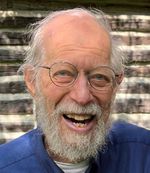
Roger Clemence
Roger Clemence met the world with progressive values, deep curiosity, and an open-hearted capacity for joy. He believed in people, in education, and in the power of places to become more generous and humane. He found beauty in what others might overlook: old houses, worn landscapes, ordinary streets, the work of building and repairing, and the possibility that design could help people live with more dignity, comfort, and delight.
Roger, Professor Emeritus of Architecture and Landscape Architecture at the University of Minnesota, died peacefully of complications from dementia on the morning of June 6 at the Pete Moore Hospice House in Eugene, Oregon. In his final weeks in hospice, he was held in love by Gretchen, his wife of nearly 65 years, and by his children and grandchildren, who gathered with tenderness, gratitude, and love.
Roger was born in Worcester, Massachusetts, in 1936 and grew up in Southbridge, the devoted only child of Dorothy Kay Clemence and Luther Clemence, and later a loving son-in-law to Janet and Paul Weinandy. His father owned the Clemence Lumber Company, a family business rooted in several generations of timber, trade, and local life, and it was widely assumed that Roger would one day take over the company. Instead, he chose to pursue architecture. When he told his parents of this desire, they supported him fully. He remained deeply grateful for that encouragement, and he offered the same generosity to his students.
Roger attended Worcester Academy and Amherst College before earning graduate degrees in architecture and landscape architecture at the University of Pennsylvania, where he studied with influential teachers including Robert Venturi and Ian McHarg.
He joined the faculty of the University of Minnesota in 1966 and taught there for more than thirty years. He moved easily among architecture, landscape architecture, urban studies, and American studies, not because he was uninterested in disciplinary boundaries, but because he understood that places do not observe them. Buildings, landscapes, communities, histories, and lives are always entangled. His work was to help others see those connections.
Roger served as Director of Graduate Studies, Director of Undergraduate Studies, and Interim Dean of the College of Architecture and Landscape Architecture. He received the University of Minnesota’s Horace T. Morse–Minnesota Alumni Distinguished Teaching Award in 1974 and CALA’s Frederick Mann Award for Disciplinary Service in 1994. In 1989, he was named a Fellow of the American Society of Landscape Architects.
He was especially proud of teaching Meanings of Place, a course that expressed one of his deepest convictions: that where we are shapes who we become. With his colleague Judith Martin, he helped create the accompanying public television program, extending those ideas beyond the classroom and into the Twin Cities themselves. Walking through neighborhoods, streets, parks, and yards, they explored how spatial practices are embedded in ordinary places, and how trees, buildings, paths, and public spaces shape everyday life. He once described his work as “helping orchestrate opportunities for students and community members to learn from one another.” That was Roger’s gift: not simply to teach, but to create the conditions in which people could discover what they already carried within them.
For generations of students, Roger was more than a professor. He was a mentor, advocate, and friend, remembered for his generosity, humility, curiosity, humor, and unwavering belief in the potential of others. He had a rare ability to see promise in people before they could fully see it in themselves.
With Gretchen, Roger created a secure and creative foundation for their three children, one filled with opportunity, freedom, and love. Their home was full of words, conversation, ideas, and beauty. They were regulars at the St. Paul Chamber Orchestra; Roger read poetry, often aloud. Gretchen’s creativity takes many forms, including watercolor painting, batik, weaving, cooking, and gardening. Together, they renovated, rearranged, and reimagined their homes. Their lives were deeply intertwined, their differences balancing and enlivening one another: Gretchen practical and grounded; Roger expansive and imaginative, a little disorganized, always full of words and ideas, and often running a few minutes behind.
Together they traveled across the United States, including every inch of Route 20, taking long road trips that carried them through much of the country, with Roger delighting in the stories those journeys produced. As one friend remembered, he had “a twinkle in his eye, a story to tell, and of course a limerick to pen.” He was ready with a toast at nearly every celebration—funny, punny, gently teasing, and always kind.
Roger and Gretchen gardened on summer evenings in their Lowry Hill yard, where he was well known for raking beneath the twenty-one oak trees. In 1970, they bought a farm in Wilson, Wisconsin, back-to-the-land curious and not entirely prepared, but somehow they made it work. In 1999, they finished the house Roger had designed, inspired by his New England childhood home and reimagined with the playful eye of an architecture professor: a bridge, a loft, a reading nook, a large screened porch, and unexpected places to wander, pause, and discover.
Roger was a word guy, pronouncing every syllable. He wasn’t macho or classically handsome, but he had a way of looking wonderful in photographs—collared shirt, navy-blue beret, and that warm, unmistakable smile. Picture him in the seventies: turtleneck under a tweed jacket with elbow patches, jeans and work boots, a full beard, and a generous puff of unruly hair.
Roger loved landscape in many forms: golf in his youth, including his favorite bragging point as club champion of the 1955 Cohasse Country Club golf tournament; long drives and careful looking; summers mowing lawns at the farm; family visits to Camp UniStar on Star Island in Cass Lake, Minnesota; pilgrimages to Southbridge and Cape Cod; summer weekends on Madeline Island with dear friends Lenore and Charlie Rodman; and later, in Oregon, the Metolius River.
Roger and Gretchen were deeply devoted to the First Unitarian Society of Minneapolis, a community that reflected their shared humanist values of inquiry, kindness, service, and care for others. During his final weeks in Eugene, two former students traveled across the country to say goodbye. He held their gazes and attention, sparkly-eyed as ever.
Roger is survived by his wife, Gretchen Clemence; his children, Peter Clemence (Alison Cohen Rosa), Ben Clemence (Lisa Helminiak), and Liska Chan (Francis Chan); his grandchildren, Aidan Clemence, Lydia Clemence, and Leo Chan; and Sol Holsather, to whom he played a significant and loving grandparent-like role. He is also remembered by extended family, beloved friends, colleagues, and generations of former students.
A gathering to honor Roger’s life will be announced later. In lieu of flowers, the family invites those who knew Roger to spend time in a place they love, and to reach out to a teacher or mentor who helped them become who they are. Gifts in his memory may be made to the University of Minnesota, including for the Girard Kay Gray Fellowship for Collaborative Leadership and the Clemence Award for Design Excellence.
Ben Clemence
2 months ago
This is a wonderful platform to share memories of Roger. Some of those photos are new to me.
The one of our family in 1970 is amazing. The sculpture! The Twins jacket Pete has on. Liska Lil’ bit.
Hard to believe he’s not around to call or visit. We had a great time watching the world around us. Photographing, looking at architecture. Appreciating nature. Just being.
He will remain with us in so many ways.
Dayana
2 months ago
Some people enter your life quietly, and before you realize it, they leave a mark that lasts forever. Roger was one of those people.
It was incredibly easy to love him. He made me feel seen, appreciated, and happy simply by being himself. He was like that sun spot that we look for when we are cold, and spending time with him was something to look forward to
(Maybe that's why letting him go has been so incredibly hard) It's difficult to accept that we won't hear his laughter again, watch him tell another story with his expressive hands, hear more jokes, or watching the same golf tournament with him over and over
Thank you, Roger, for showing me how deeply I could care for someone. I never imagined that walking into your life would change mine forever.
I keep replaying the little things, the things that seemed ordinary then but now feel priceless, tthank you for every conversation, every laugh, and every moment we shared (even the moments you were mad were so funny)
Once I heard that grief is the price we pay for love, I understand perfectly that now
What began as a job became one of the greatest privileges of my life
You taught me that caring for someone isn't only about helping them through their hardest days it's about allowing your heart to be changed forever (just like you did with mine)
I hope heaven has the most beautiful golf course waiting for you. Until we meet again, you'll be missed, remembered, and loved always. Rest in peace, Roger
Ben Clemence replied
2 months ago
What a beautiful and touching tribute Dayana. Thank you for your heartfelt words and for being such a supportive and kind friend to Roger. You each brightened each other’s days with your positive energy and warmth.
Candi
2 months ago
It has been an honor to know Roger and hear his stories, full of life, art and love. He was always making me laugh, and had an unwavering kindness even on days that were hard for him personally. Roger’s commitment to teaching and his students was passed on to Liska, who was an incredibly supportive and compassionate teacher during my time at the University of Oregon. The love that Gretchen and Roger shared is an inspirational example of life long partnership. Thank you Roger, Gretchen and Liska for letting me witness a small part of your beautiful life and family. - Signed Candi, your old cook and admirer
Liska Chan
2 months ago
Gretchen would love to hear from you! ❤️
Gretchen Clemence
2470 Jefferson St. Eugene, OR
97405
458-221-3325
Ruth Agar
2 months ago
What a full and loving story of one of the best human beings I have known — and all the photos!!! My memories of Roger are always happy, often learning something brand new to me :)!