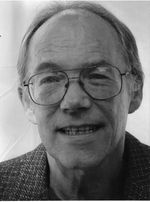
George Riney Brown, singular and largely self-taught, gentle and engaged, was perhaps best known publicly as the founder and co-owner of The Kiva Grocery & Deli and as Eugene city council person for eight years. To his friends and family, he was loved for his wry humor, quick comebacks, and his ability to talk at length about anything. He was humble, often eloquent and sometimes awkward, the epitome of nerdy hippie cool. He spoke five languages and enjoyed books and records and caring for the plants he’d collected from around the world. He died June 23 of vascular disease in the living room of his South Hills home surrounded by family and holding the hand of his oldest friend. He was 79.
George was always learning and synthesizing his knowledge and experiences and talking about them—sometimes for hours at a time (even if the listener was no longer engaged). He was a human encyclopedia. Not just cerebral, he developed every aspect of his human-ness—as an explorer, traveler, reveler in absurd humor, in the natural world, in animals. He rescued many in his lifetime, including a monkey, several dogs, a Prairie Falcon, a Flicker, and a baby Scrub-jay he found in the bushes outside Kiva one morning. He hand-raised “Birdy,” and she rode around on his shoulder, even making a road trip to Kansas with him.
His story was the story of Eugene in many ways: a migration from elsewhere in the early seventies, so many seekers finding the lush congruence of values with lifestyle and creating businesses that mirrored their idealism and shaped the culture of the town.
George was born April 12, 1947, in Wichita, Kansas, the fourth of six children, in a close, service-oriented family. His father was a WWII veteran, civic leader, and TV executive who started the first NBC affiliate in Kansas. George grew up beside his best friends, John (brother), Cobe (whom he met when they were four and squabbled because George thought Cobe had taken his trike), Zeke, and Dick (friends since junior high). George and his friends ice-skated and sledded and went to movies on Saturday afternoons. They explored buildings in downtown Wichita, having found skeleton keys that opened many doors for them, including to the Orpheum Theater. George took an epic railroad trip with his brother when they were in grade school to stay with their aunt and uncle in California. They went to a Dodgers game (he was a lifelong fan) and to San Diego and San Francisco, cementing George’s love of adventure and of the West Coast. He began driving to eastern Washington to work in the apple orchards the summer after 8th grade. Unsurprisingly, George was an Eagle Scout.
He was a good student and earned his Bachelor of Arts degree in anthropology from the University of Kansas. He worked various jobs including as a housepainter, a waiter, a boat factory line worker, a bartender, and an inventory clerk. He and a few friends were picking apples one summer and drove down through Eugene where they thought it would be a good place to build a business. They leased a garage on the corner of 11th and Oak, which became Scarborough Faire, where you could buy a floral-tooled leather belt or a miso broccoli sandwich or a book from the store George ran, The Kiva. The mall opened on Halloween, 1970. “To all of our surprise George hung around and drank his wine and read his books,” says his good friend Joe Mann, another founding member.
George moved The Kiva to its current location on West 11th Ave and Olive Street in 1983. He bought organic produce from small farms and supported other local businesses and organic food distributors, building relationships that last to this day. The Kiva remains a touchstone of familiar faces and organic values, an anchor tenant in downtown Eugene. George was good to his employees, with many staying on for their whole careers.
After a long bachelorhood, he fell in love with a smart, bright-eyed former Kiva clerk, Melissa, who he called Mel. After maintaining a long-distance relationship when she was living in Arizona, they married at the Lane County Courthouse in 2003. They became business partners and parents to a son, George.
They traveled to rural Kansas most summers to spend time with his family, staying in an old cabin with its big screened-in porch and long picnic table looking out on Clear Lake, a gathering spot for the extended Brown family for over 100 years.
George was an unflappable traveler and went all over Mexico and Central America and the American West. He traveled to Italy, the UK, Egypt, Jordan, Israel, Cuba, and Japan. No matter what, he was always fine even after getting three flat tires on a remote road in Belize. Or getting off a bus in Egypt to have a smoke and leaving his passport and wallet on the bus—and randomly being able to catch up with the bus at the Suez Canal.
He was unruffled by most things except for our current national political scene, shoplifting, and non-customers parking in the Kiva parking lot. George was sober for the last eighteen years of his life. Despite being surrounded by wholesome food, he loved “treats” and a sticky convenience store “cappuccino.” He also loved a good-not-so-PC joke and old TV or radio jingles that he would change the words to. Anything he heard you say that was funny, he would repeat.
When he was running for his first term on the council, he made a pledge to knock on every door in Ward 1—meeting thousands of future constituents. He was skeptical about public funding or tax breaks being used for private development (such as Capstone student housing) under the guise of “urban renewal.” He always did his homework, carrying armloads of binders into city council meetings, well prepared with his arguments. He was often on the losing side of major council votes; this didn’t bother him if he believed he was doing the right thing.
He was as humble in politics as he was in life. He worked hard to save Civic Stadium and doesn’t get much credit for it. When the stadium was abandoned, George joined the crew that maintained the structure and grounds. He dug out blackberries, pulled weeds, and repaired fences, anything that needed doing. Not for votes, just out of caring. The site was ultimately saved for what is now Civic Park.
With his rumpled clothes, he used to sweep in front of The Kiva each day. On more than one occasion, a customer would thank one of the staff in the store for giving work to the scruffy man with the glasses out front, having no idea he was likely their representative on the city council.
George leaves hundreds of legal pads scribbled with notes, boxes upon boxes of black-and-white photos, old letters, maps, seed packets; a collection of records—everything from opera to Sudanese tribal chanting to Tone Loc. He leaves a collection of cherished if not well cared for books, which were another great love of his life. Every morning, he would sit in the greenhouse he built in his large backyard smoking and thinking. We picture him there, sometimes reading, one eye squinting, laughing.
In the week before his death, George wanted to see his books at The Kiva, to make a (final) book order. His family carried him down the steps of his house and into the car for the short ride downtown. He sat in the store in front of his bookshelves until he was ready to come home.
George is survived by his wife, Melissa, and their son, George; siblings Rebecca Vaughan, of Kansas City, Missouri, and Thomas (Susan) Brown of Cleveland, Ohio; Sister-in-law Ofra Confino; many MANY beloved nieces and nephews; a large extended family; life-long friends; Big Baby, his Great Pyrenees; and Blaze the cat. He was preceded in death by parents, George and Mary Brown; sisters Lynn (Joseph) Culver and Sally Brown Crank; brother John Brown (John, who died in 2013, was one of the greatest loves of George’s life); and succession of cats and dogs, including Annie, Dutchie, Sheba, Eve, Bandit, Pip and Dottie.
Comments
We invite you to add to the story
Be the first to post a note or a memory
Add a comment